LangNation
Courses Browse courses Regular One-to-one Intensive Placement test
Exams Exam papers Study material Einbürgerungstest
Germany Living and studying in Germany Study in Germany The German school system Your first weeks Working in Germany
Tools German grade ECTS credits Overall band TOEFL ⇄ IELTS converter
About us About Events Gallery Blog FAQ
Contact Request a call back Deutsch
  1. Frage 151 Geschichte und Verantwortung

    Wer baute die Mauer in Berlin?

    1. Großbritannien
    2. die DDR richtig
    3. die Bundesrepublik Deutschland
    4. die USA
    In English

    Who built the Wall in Berlin?

    1. A Great Britain
    2. B the GDR (East Germany)
    3. C the Federal Republic of Germany
    4. D the USA

    Unofficial translation, to help you read the question. Only the German wording counts in the exam.

    Warum? Die Mauer baute die DDR, um die Flucht der eigenen Bevölkerung nach Westen zu stoppen. Offiziell hieß sie „antifaschistischer Schutzwall“.
  2. Frage 152 Geschichte und Verantwortung

    Wann waren die Nationalsozialisten mit Adolf Hitler in Deutschland an der Macht?

    1. 1918 bis 1923
    2. 1932 bis 1950
    3. 1933 bis 1945 richtig
    4. 1945 bis 1989
    In English

    When were the National Socialists under Adolf Hitler in power in Germany?

    1. A 1918 to 1923
    2. B 1932 to 1950
    3. C 1933 to 1945
    4. D 1945 to 1989

    Unofficial translation, to help you read the question. Only the German wording counts in the exam.

    Warum? Vom 30. Januar 1933, als Hitler Reichskanzler wurde, bis zur Kapitulation im Mai 1945.

  3. Frage 153 Geschichte und Verantwortung

    Was war am 8. Mai 1945?

    1. Tod Adolf Hitlers
    2. Beginn des Berliner Mauerbaus
    3. Wahl von Konrad Adenauer zum Bundeskanzler
    4. Ende des Zweiten Weltkriegs in Europa richtig
    In English

    What happened on 8 May 1945?

    1. A the death of Adolf Hitler
    2. B the start of the building of the Berlin Wall
    3. C the election of Konrad Adenauer as Federal Chancellor
    4. D the end of the Second World War in Europe

    Unofficial translation, to help you read the question. Only the German wording counts in the exam.

    Warum? Der 8. Mai 1945 ist der Tag der bedingungslosen Kapitulation der Wehrmacht. In Deutschland heißt er heute Tag der Befreiung.

  4. Frage 154 Geschichte und Verantwortung

    Wann war der Zweite Weltkrieg zu Ende?

    1. 1933
    2. 1945 richtig
    3. 1949
    4. 1961
    In English

    When did the Second World War end?

    1. A 1933
    2. B 1945
    3. C 1949
    4. D 1961

    Unofficial translation, to help you read the question. Only the German wording counts in the exam.

    Warum? In Europa am 8. Mai 1945, in Asien im September 1945.

  5. Frage 155 Geschichte und Verantwortung

    Wann waren die Nationalsozialisten in Deutschland an der Macht?

    1. 1888 bis 1918
    2. 1921 bis 1934
    3. 1933 bis 1945 richtig
    4. 1949 bis 1963
    In English

    When were the National Socialists in power in Germany?

    1. A 1888 to 1918
    2. B 1921 to 1934
    3. C 1933 to 1945
    4. D 1949 to 1963

    Unofficial translation, to help you read the question. Only the German wording counts in the exam.

    Warum? Wie Nr. 152: 1933 bis 1945.

  6. Frage 156 Geschichte und Verantwortung

    In welchem Jahr wurde Hitler Reichskanzler?

    1. 1923
    2. 1927
    3. 1933 richtig
    4. 1936
    In English

    In which year did Hitler become Reich Chancellor?

    1. A 1923
    2. B 1927
    3. C 1933
    4. D 1936

    Unofficial translation, to help you read the question. Only the German wording counts in the exam.

    Warum? Am 30. Januar 1933 ernannte Reichspräsident Hindenburg Hitler zum Reichskanzler. Innerhalb weniger Monate war aus der Republik eine Diktatur geworden.

  7. Frage 157 Geschichte und Verantwortung

    Die Nationalsozialisten mit Adolf Hitler errichteten 1933 in Deutschland …

    1. eine Diktatur. richtig
    2. einen demokratischen Staat.
    3. eine Monarchie.
    4. ein Fürstentum.
    In English

    In 1933 the National Socialists under Adolf Hitler established in Germany …

    1. A a dictatorship.
    2. B a democratic state.
    3. C a monarchy.
    4. D a principality.

    Unofficial translation, to help you read the question. Only the German wording counts in the exam.

    Warum? Parteien wurden verboten, Gegner verhaftet, die Presse gleichgeschaltet. Das Ermächtigungsgesetz vom März 1933 schaltete das Parlament aus.

  8. Frage 158 Geschichte und Verantwortung

    Das "Dritte Reich" war eine …

    1. Diktatur. richtig
    2. Demokratie.
    3. Monarchie.
    4. Räterepublik.
    In English

    The "Third Reich" was a …

    1. A dictatorship.
    2. B democracy.
    3. C monarchy.
    4. D council republic.

    Unofficial translation, to help you read the question. Only the German wording counts in the exam.

    Warum? „Drittes Reich“ war der Name, den die Nationalsozialisten ihrem Staat gaben. Er war von Anfang an eine Diktatur.

  9. Frage 159 Geschichte und Verantwortung

    Was gab es in Deutschland nicht während der Zeit des Nationalsozialismus?

    1. freie Wahlen richtig
    2. Pressezensur
    3. willkürliche Verhaftungen
    4. Verfolgung von Juden
    In English

    Which of these did not exist in Germany during the National Socialist period?

    1. A free elections
    2. B censorship of the press
    3. C arbitrary arrests
    4. D persecution of Jews

    Unofficial translation, to help you read the question. Only the German wording counts in the exam.

    Warum? Nach 1933 gab es keine freien Wahlen mehr. Zensur, willkürliche Verhaftungen und die Verfolgung der Juden gab es sehr wohl.

  10. Frage 160 Geschichte und Verantwortung

    Welcher Krieg dauerte von 1939 bis 1945?

    1. der Erste Weltkrieg
    2. der Zweite Weltkrieg richtig
    3. der Vietnamkrieg
    4. der Golfkrieg
    In English

    Which war lasted from 1939 to 1945?

    1. A the First World War
    2. B the Second World War
    3. C the Vietnam War
    4. D the Gulf War

    Unofficial translation, to help you read the question. Only the German wording counts in the exam.

    Warum? Der Zweite Weltkrieg begann am 1. September 1939 mit dem deutschen Angriff auf Polen.

  11. Frage 161 Geschichte und Verantwortung

    Was kennzeichnete den NS-Staat? Eine Politik …

    1. des staatlichen Rassismus richtig
    2. der Meinungsfreiheit
    3. der allgemeinen Religionsfreiheit
    4. der Entwicklung der Demokratie
    In English

    What characterised the Nazi state? A policy …

    1. A of state racism
    2. B of freedom of expression
    3. C of general freedom of religion
    4. D of developing democracy

    Unofficial translation, to help you read the question. Only the German wording counts in the exam.

    Warum? Der NS-Staat machte Rassismus zum Gesetz: die Nürnberger Gesetze, die Verfolgung und schließlich die Ermordung der europäischen Juden.

  12. Frage 162 Geschichte und Verantwortung

    Claus Schenk Graf von Stauffenberg wurde bekannt durch …

    1. eine Goldmedaille bei den Olympischen Spielen 1936.
    2. den Bau des Reichstagsgebäudes.
    3. den Aufbau der Wehrmacht.
    4. das Attentat auf Hitler am 20. Juli 1944. richtig
    In English

    Claus Schenk Graf von Stauffenberg became known for …

    1. A a gold medal at the 1936 Olympic Games.
    2. B building the Reichstag building.
    3. C building up the Wehrmacht.
    4. D the attempt to assassinate Hitler on 20 July 1944.

    Unofficial translation, to help you read the question. Only the German wording counts in the exam.

    Warum? Stauffenberg legte am 20. Juli 1944 eine Bombe in Hitlers Lagebesprechung. Das Attentat misslang; er wurde noch in derselben Nacht erschossen.

  13. Frage 163 Geschichte und Verantwortung

    In welchem Jahr zerstörten die Nationalsozialisten Synagogen und jüdische Geschäfte in Deutschland?

    1. 1925
    2. 1930
    3. 1938 richtig
    4. 1945
    In English

    In which year did the National Socialists destroy synagogues and Jewish shops in Germany?

    1. A 1925
    2. B 1930
    3. C 1938
    4. D 1945

    Unofficial translation, to help you read the question. Only the German wording counts in the exam.

    Warum? In der Nacht vom 9. auf den 10. November 1938 — den Novemberpogromen.

  14. Frage 164 Geschichte und Verantwortung

    Was passierte am 9. November 1938 in Deutschland?

    1. Mit dem Angriff auf Polen beginnt der Zweite Weltkrieg.
    2. Die Nationalsozialisten verlieren eine Wahl und lösen den Reichstag auf.
    3. Jüdische Geschäfte und Synagogen werden durch Nationalsozialisten und ihre Anhänger zerstört. richtig
    4. Hitler wird Reichspräsident und lässt alle Parteien verbieten.
    In English

    What happened in Germany on 9 November 1938?

    1. A The Second World War begins with the attack on Poland.
    2. B The National Socialists lose an election and dissolve the Reichstag.
    3. C Jewish shops and synagogues are destroyed by National Socialists and their supporters.
    4. D Hitler becomes Reich President and has all parties banned.

    Unofficial translation, to help you read the question. Only the German wording counts in the exam.

    Warum? Die Novemberpogrome: Synagogen brannten, jüdische Geschäfte wurden zerstört, Zehntausende wurden verhaftet.

  15. Frage 165 Geschichte und Verantwortung

    Wie hieß der erste Bundeskanzler der Bundesrepublik Deutschland?

    1. Konrad Adenauer richtig
    2. Kurt Georg Kiesinger
    3. Helmut Schmidt
    4. Willy Brandt
    In English

    What was the name of the first Federal Chancellor of the Federal Republic of Germany?

    1. A Konrad Adenauer
    2. B Kurt Georg Kiesinger
    3. C Helmut Schmidt
    4. D Willy Brandt

    Unofficial translation, to help you read the question. Only the German wording counts in the exam.

    Warum? Konrad Adenauer war von 1949 bis 1963 der erste Bundeskanzler.

  16. Frage 166 Geschichte und Verantwortung

    Bei welchen Demonstrationen in Deutschland riefen die Menschen "Wir sind das Volk"?

    1. beim Arbeiteraufstand 1953 in der DDR
    2. bei den Demonstrationen 1968 in der Bundesrepublik Deutschland
    3. bei den Anti-Atomkraft-Demonstrationen 1985 in der Bundesrepublik Deutschland
    4. bei den Montagsdemonstrationen 1989 in der DDR richtig
    In English

    At which demonstrations in Germany did people chant "Wir sind das Volk" ("We are the people")?

    1. A at the workers' uprising of 1953 in the GDR
    2. B at the demonstrations of 1968 in the Federal Republic of Germany
    3. C at the anti-nuclear demonstrations of 1985 in the Federal Republic of Germany
    4. D at the Monday demonstrations of 1989 in the GDR

    Unofficial translation, to help you read the question. Only the German wording counts in the exam.

    Warum? Bei den Montagsdemonstrationen im Herbst 1989, vor allem in Leipzig. Der Ruf war an die eigene Regierung gerichtet.

  17. Frage 167 Geschichte und Verantwortung

    Welche Länder wurden nach dem Zweiten Weltkrieg in Deutschland als "Alliierte Besatzungsmächte" bezeichnet?

    1. Sowjetunion, Großbritannien, Polen, Schweden
    2. Frankreich, Sowjetunion, Italien, Japan
    3. USA, Sowjetunion, Spanien, Portugal
    4. USA, Sowjetunion, Großbritannien, Frankreich richtig
    In English

    Which countries were known as the "Allied occupying powers" in Germany after the Second World War?

    1. A Soviet Union, Great Britain, Poland, Sweden
    2. B France, Soviet Union, Italy, Japan
    3. C USA, Soviet Union, Spain, Portugal
    4. D USA, Soviet Union, Great Britain, France

    Unofficial translation, to help you read the question. Only the German wording counts in the exam.

    Warum? Die vier Siegermächte: USA, Sowjetunion, Großbritannien und Frankreich. Sie teilten Deutschland in vier Besatzungszonen.

  18. Frage 168 Geschichte und Verantwortung

    Welches Land war keine "Alliierte Besatzungsmacht" in Deutschland?

    1. USA
    2. Sowjetunion
    3. Frankreich
    4. Japan richtig
    In English

    Which country was not an "Allied occupying power" in Germany?

    1. A USA
    2. B Soviet Union
    3. C France
    4. D Japan

    Unofficial translation, to help you read the question. Only the German wording counts in the exam.

    Warum? Japan war Verbündeter des Deutschen Reichs und selbst besetzt — nicht Besatzungsmacht in Deutschland.

  19. Frage 169 Geschichte und Verantwortung

    Wann wurde die Bundesrepublik Deutschland gegründet?

    1. 1939
    2. 1945
    3. 1949 richtig
    4. 1951
    In English

    When was the Federal Republic of Germany founded?

    1. A 1939
    2. B 1945
    3. C 1949
    4. D 1951

    Unofficial translation, to help you read the question. Only the German wording counts in the exam.

    Warum? Am 23. Mai 1949 trat das Grundgesetz in Kraft. Das ist die Geburtsstunde der Bundesrepublik.

  20. Frage 170 Geschichte und Verantwortung

    Was gab es während der Zeit des Nationalsozialismus in Deutschland?

    1. das Verbot von Parteien richtig
    2. das Recht zur freien Entfaltung der Persönlichkeit
    3. Pressefreiheit
    4. den Schutz der Menschenwürde
    In English

    Which of these existed in Germany during the National Socialist period?

    1. A the banning of political parties
    2. B the right to free development of the personality
    3. C freedom of the press
    4. D the protection of human dignity

    Unofficial translation, to help you read the question. Only the German wording counts in the exam.

    Warum? Alle Parteien außer der NSDAP wurden 1933 verboten. Pressefreiheit und Menschenwürde gab es nicht.

  21. Frage 171 Geschichte und Verantwortung

    Soziale Marktwirtschaft bedeutet, die Wirtschaft …

    1. steuert sich allein nach Angebot und Nachfrage.
    2. wird vom Staat geplant und gesteuert, Angebot und Nachfrage werden nicht berücksichtigt.
    3. richtet sich nach der Nachfrage im Ausland.
    4. richtet sich nach Angebot und Nachfrage, aber der Staat sorgt für einen sozialen Ausgleich. richtig
    In English

    A social market economy means that the economy …

    1. A regulates itself purely by supply and demand.
    2. B is planned and directed by the state, with supply and demand disregarded.
    3. C follows demand from abroad.
    4. D follows supply and demand, but the state provides for social balance.

    Unofficial translation, to help you read the question. Only the German wording counts in the exam.

    Warum? Der Markt regelt, der Staat gleicht aus — über Sozialversicherung, Kündigungsschutz und Steuern.

  22. Frage 172 Geschichte und Verantwortung

    In welcher Besatzungszone wurde die DDR gegründet? In der …

    1. amerikanischen Besatzungszone
    2. französischen Besatzungszone
    3. britischen Besatzungszone
    4. sowjetischen Besatzungszone richtig
    In English

    In which occupation zone was the GDR founded? In the …

    1. A American occupation zone
    2. B French occupation zone
    3. C British occupation zone
    4. D Soviet occupation zone

    Unofficial translation, to help you read the question. Only the German wording counts in the exam.

    Warum? Die DDR entstand aus der sowjetischen Besatzungszone, die Bundesrepublik aus den drei westlichen.

  23. Frage 173 Geschichte und Verantwortung

    Die Bundesrepublik Deutschland ist ein Gründungsmitglied …

    1. des Nordatlantikpakts (NATO).
    2. der Vereinten Nationen (VN).
    3. der Europäischen Union (EU). richtig
    4. des Warschauer Pakts.
    In English

    The Federal Republic of Germany is a founding member of …

    1. A the North Atlantic Treaty Organisation (NATO).
    2. B the United Nations (UN).
    3. C the European Union (EU).
    4. D the Warsaw Pact.

    Unofficial translation, to help you read the question. Only the German wording counts in the exam.

    Warum? Gründungsmitglied der EWG 1957 und der EU 1993. Der NATO trat die Bundesrepublik erst 1955 bei, den Vereinten Nationen 1973.

  24. Frage 174 Geschichte und Verantwortung

    Wann wurde die DDR gegründet?

    1. 1947
    2. 1949 richtig
    3. 1953
    4. 1956
    In English

    When was the GDR founded?

    1. A 1947
    2. B 1949
    3. C 1953
    4. D 1956

    Unofficial translation, to help you read the question. Only the German wording counts in the exam.

    Warum? Im selben Jahr wie die Bundesrepublik: 1949, einige Monate später.

  25. Frage 175 Geschichte und Verantwortung

    Wie viele Besatzungszonen gab es in Deutschland nach dem Zweiten Weltkrieg?

    1. 3
    2. 4 richtig
    3. 5
    4. 6
    In English

    How many occupation zones were there in Germany after the Second World War?

    1. A 3
    2. B 4
    3. C 5
    4. D 6

    Unofficial translation, to help you read the question. Only the German wording counts in the exam.

    Warum? Vier: eine amerikanische, eine britische, eine französische und eine sowjetische. Berlin wurde zusätzlich in vier Sektoren geteilt.

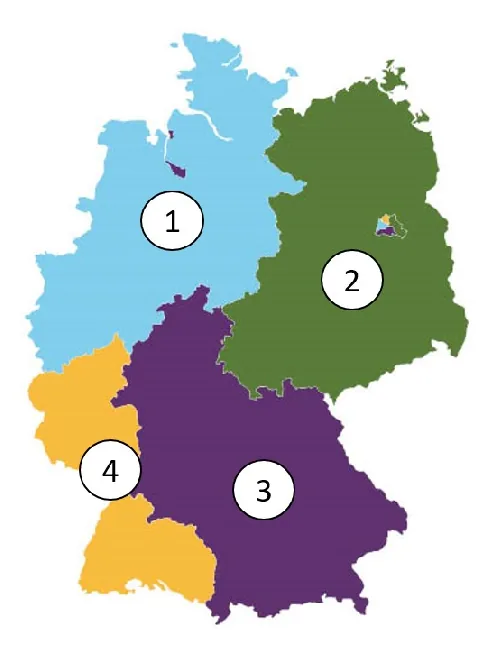
  26. Frage 176 Geschichte und Verantwortung

    Wie waren die Besatzungszonen Deutschlands nach 1945 verteilt?

    Abbildung zu Frage 176
    1. 1=Großbritannien, 2=Sowjetunion, 3=Frankreich, 4=USA
    2. 1=Sowjetunion, 2=Großbritannien, 3=USA, 4=Frankreich
    3. 1=Großbritannien, 2=Sowjetunion, 3=USA, 4=Frankreich richtig
    4. 1=Großbritannien, 2=USA, 3=Sowjetunion, 4=Frankreich
    In English

    How were Germany's occupation zones distributed after 1945?

    1. A 1=Great Britain, 2=Soviet Union, 3=France, 4=USA
    2. B 1=Soviet Union, 2=Great Britain, 3=USA, 4=France
    3. C 1=Great Britain, 2=Soviet Union, 3=USA, 4=France
    4. D 1=Great Britain, 2=USA, 3=Soviet Union, 4=France

    Unofficial translation, to help you read the question. Only the German wording counts in the exam.

    Warum? Großbritannien im Nordwesten, die Sowjetunion im Osten, die USA im Süden, Frankreich im Südwesten.

  27. Frage 177 Geschichte und Verantwortung

    Welche deutsche Stadt wurde nach dem Zweiten Weltkrieg in vier Sektoren aufgeteilt?

    1. München
    2. Berlin richtig
    3. Dresden
    4. Frankfurt/Oder
    In English

    Which German city was divided into four sectors after the Second World War?

    1. A Munich
    2. B Berlin
    3. C Dresden
    4. D Frankfurt (Oder)

    Unofficial translation, to help you read the question. Only the German wording counts in the exam.

    Warum? Berlin lag mitten in der sowjetischen Zone, wurde aber selbst in vier Sektoren geteilt. Daraus wurde später West- und Ost-Berlin.

  28. Frage 178 Geschichte und Verantwortung

    Vom Juni 1948 bis zum Mai 1949 wurden die Bürgerinnen und Bürger von West-Berlin durch eine Luftbrücke versorgt. Welcher Umstand war dafür verantwortlich?

    1. Für Frankreich war eine Versorgung der West-Berliner Bevölkerung mit dem Flugzeug kostengünstiger.
    2. Die amerikanischen Soldatinnen und Soldaten hatten beim Landtransport Angst vor Überfällen.
    3. Für Großbritannien war die Versorgung über die Luftbrücke schneller.
    4. Die Sowjetunion unterbrach den gesamten Verkehr auf dem Landwege. richtig
    In English

    From June 1948 to May 1949 the citizens of West Berlin were supplied by an airlift. What made that necessary?

    1. A For France, supplying the West Berlin population by air was cheaper.
    2. B American soldiers were afraid of attacks on land transport.
    3. C For Great Britain, supply by airlift was faster.
    4. D The Soviet Union cut off all traffic by land.

    Unofficial translation, to help you read the question. Only the German wording counts in the exam.

    Warum? Die Sowjetunion sperrte alle Land- und Wasserwege nach West-Berlin. Fast ein Jahr lang kam alles per Flugzeug — die „Rosinenbomber“.

  29. Frage 179 Geschichte und Verantwortung

    Wie endete der Zweite Weltkrieg in Europa offiziell?

    1. mit dem Tod Adolf Hitlers
    2. durch die bedingungslose Kapitulation Deutschlands richtig
    3. mit dem Rückzug der Deutschen aus den besetzten Gebieten
    4. durch eine Revolution in Deutschland
    In English

    How did the Second World War officially end in Europe?

    1. A with the death of Adolf Hitler
    2. B with Germany's unconditional surrender
    3. C with the German withdrawal from the occupied territories
    4. D through a revolution in Germany

    Unofficial translation, to help you read the question. Only the German wording counts in the exam.

    Warum? Mit der bedingungslosen Kapitulation der Wehrmacht am 8. Mai 1945. Hitlers Tod eine Woche zuvor beendete den Krieg nicht.

  30. Frage 180 Geschichte und Verantwortung

    Der erste Bundeskanzler der Bundesrepublik Deutschland war …

    1. Ludwig Erhard.
    2. Willy Brandt.
    3. Konrad Adenauer. richtig
    4. Gerhard Schröder.
    In English

    The first Federal Chancellor of the Federal Republic of Germany was …

    1. A Ludwig Erhard.
    2. B Willy Brandt.
    3. C Konrad Adenauer.
    4. D Gerhard Schröder.

    Unofficial translation, to help you read the question. Only the German wording counts in the exam.

    Warum? Wie Nr. 165: Konrad Adenauer, 1949 bis 1963.

Fragen und Abbildungen aus dem amtlichen Gesamtfragenkatalog des Bundesamtes für Migration und Flüchtlinge, Stand 2025-05-07. LangNation ist ein unabhängiges Lernangebot und steht nicht in Verbindung mit dem Bundesamt für Migration und Flüchtlinge.